
Ample Is Not Abundant

Markets have been trained to expect a rescue. The training accumulated over time, and it was not unreasonable.
Every time markets got uncomfortable in recent years, a response arrived. The September 2019 repo spike, when overnight lending rates hit 10% on a tax payment date, triggered a series of open-market operations and eventually a return to balance-sheet expansion that the Fed was careful not to call QE. The March 2020 credit market freeze was genuine and severe, and the intervention there was appropriate. Dealer spreads in the Treasury market were widening to levels that threatened normal functioning, and a funding crisis of that severity could become much worse if it spirals. The response was right for the event.
But the response function broadened from there. The pandemic-era supports remained in place long after the acute moment passed. Rates stayed at zero. The balance sheet reached roughly $9 trillion. Then came the more ordinary episodes. Growth scares got managed. Spread widening got managed. The early 2025 tariff episode was stabilized in part through policy signals before markets had time to fully reprice the risk. Each response was defensible in isolation. The lesson they taught was cumulative.
Markets learn from the response function of the people running the system. When a response reliably arrives at every episode of discomfort, investors stop pricing in the probability that rescue will not come. They begin pricing in the certainty that it will. That changes how leverage is built, how volatility is carried, and what margin of safety means in practice.
The second piece described how surface calm gets manufactured through mechanical compression. Some of that compression is behavioral: participants carry risk at a thinner margin because they believe the backstop is guaranteed. That belief was purchased cheaply in the prior era. The fiscal backdrop for the next large intervention is not that one.
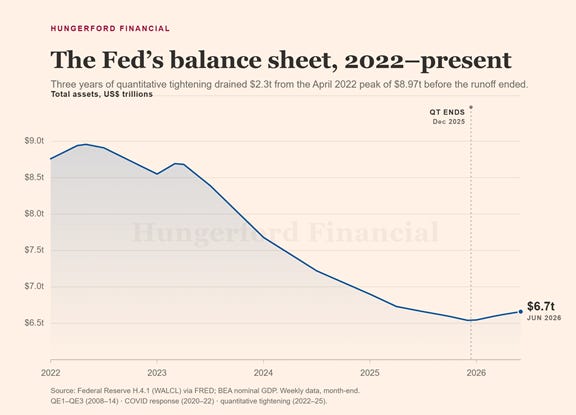
From 2022 until November 2025, the Federal Reserve reduced its securities holdings by more than $2 trillion. QT ran for roughly three and a half years. The balance sheet came down from about $9 trillion at peak to around $6.7 trillion as of mid-2026. When the Fed ended the runoff, it judged that reserves had reached an ample level.
Not abundant. Ample.
Those words sound similar. They describe different states. In an abundant-reserve regime, there is so much liquidity in the system that small changes in reserve supply barely move short-term rates. The system has excess cushion. It does not need active tending. In an ample-reserve regime, the New York Fed describes reserves as a range where the federal funds rate is only modestly sensitive to short-term supply changes. The system has enough to hold rates, but reserve dynamics are no longer something it can ignore. Rate control is maintained, but the margin is narrower. The system now needs active management to stay in range.
The footprint never normalized.
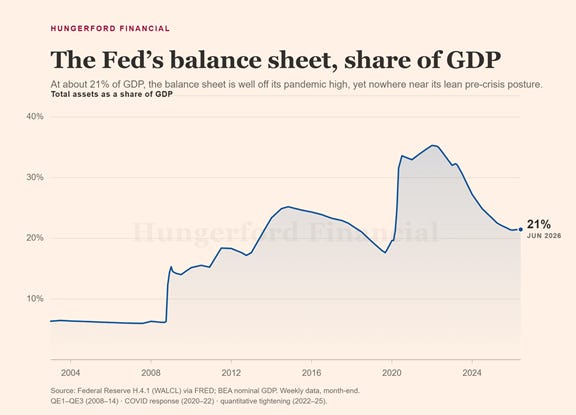
By mid-December, the Fed’s Open Market Trading Desk was directed to begin reserve management purchases of roughly $40 billion per month in Treasury bills just to hold a position within the ample range. Reserve balances were approximately $3.02 trillion as of early March 2026, up only $83 billion since the purchases began. Standing repo operations moved to twice daily. No crisis drove it. No easing cycle. The balance sheet was rising again.
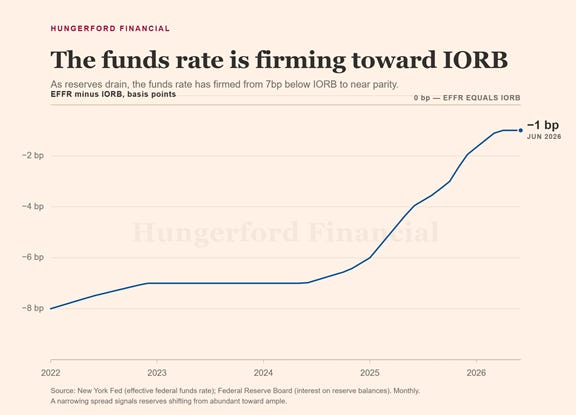
Reserves had fallen far enough to firm the rate.
As reserves fell in late 2025, the federal funds effective rate moved from 7 basis points below IORB to 1 basis point below. That is a small number. It has been moving in one direction.
Both QE and reserve management purchases require balance-sheet expansion. The Fed treats them differently in intent: rate maintenance, not financial easing. That distinction is real. But in the current fiscal environment, every dollar of balance-sheet expansion carries a question that it did not in 2012 or 2020.
Why does that matter for the response function?
The 30-year clearing above 5% for the first time since 2007 belongs in this picture too. It is consistent with something larger: the post-2008 era of suppressed term premiums was built on zero rates, large-scale asset purchases, and foreign central banks recycling dollar reserves into long-duration paper without asking hard questions about the term risk they were absorbing. If long yields are settling back toward something that looks more like history, the cost of issuing long-duration paper rises. The cost of the next large intervention rises with it.
The tools exist. The concern is what using them now costs.
In a low-deficit, low-inflation, post-crisis world, central bank intervention can be framed cleanly as plumbing support. In a higher-deficit, inflation-sensitive world with heavy Treasury issuance and a federal budget already strained by interest costs, the same intervention looks different. The market will draw its own line between liquidity support and fiscal expansion being monetized, whether or not that is the intent. The credibility cost is higher. The political room is narrower. The inflation tolerance is lower.
Printing in an inflation-sensitive environment raises the yield investors need to hold long-term paper. That is part of how the term premium reasserts itself. And it is how the credibility cost compounds with each intervention in ambiguous circumstances.
The rescue will probably come. The question is whether it arrives on the terms markets have been trained to expect: fast, clean, and with no visible side effects.
Three years of running reserves to the edge of functional adequacy, followed by a formal regime change to ample, and then $40 billion in monthly maintenance purchases just to hold position, is not a picture of unlimited dry powder. It is a picture of a system that spent its cushion managing small events and now has less margin to manage a large one.
The first piece questioned the cash cushion. The second, the calm. The third, the long end. This one questions the assumed rescue. Not because rescue is impossible. Because the terms may have changed.
That is not a reason to panic. It is a reason to know where to look.